
Almost every corporate video project reaches the same moment. Someone on the client side asks whether we should script exactly what the CEO is going to say.
My answer is almost always no. I’d rather have a short list of talking points for each person and then sit down for a real conversation on camera. I spent 17 years as a television sportscaster before two decades of producing corporate videos at Perlow Productions, and in all of that time a conversation has brought out better answers than a script.
That can be a hard sell. Executives often feel it’s important to hit every talking point exactly as written. In technical industries, marketing and other departments want to be sure every word is on point. I understand the instinct. Here’s why I push back on it, what I ask for instead, and when a script is still the right call.
The vacation test
Before an interview, I tell people the same thing. If I asked you to tell me about your last vacation, you’d have no trouble talking about it, whether it was amazing or awful. You wouldn’t need notes.
The people I interview are in the same position. They’re talking about something they know extremely well: their company, their role and their work. A conversational interview lets them speak off the cuff about it.
A script takes that away. When someone is reciting memorized lines, their mind is completely focused on remembering every word. Nothing is left over to respond to the question in front of them. Even a person who is decent at memorizing or reading a teleprompter loses the human connection with the viewer.
A conversation works differently. When I’m free to ask questions around the talking points, people very often mention something that opens another line of questioning. It might be how they first landed their job, an unusual client experience or how far they’ve climbed in the company. I follow it.
That’s where the energy changes. When people get onto something they’re passionate about, they start speaking from the heart. Sometimes they even get emotional as they recount an experience or the success of the company. No script produces that.
You can hear the difference in finished videos. In our recruiting video for ZT Systems, management and staff talk about the company in their own words. ZT’s leadership liked the completed video so much they also used it as a company overview for potential customers. Our video for CareOne includes interviews with the company’s Chairman and CEO and its Executive Vice President, and it opens with one of my favorite interview sound bites. All I did was ask a resident what brought her to CareOne. Her response was truly priceless and heartfelt. For the Cardiovascular Institute of San Diego, we interviewed three prominent cardiologists in the San Diego area.
A good script can’t fix a stiff delivery
Several years ago, we produced a video that featured the CEO of a company. All of his lines were scripted. They were written to be fun and entertaining while still being about the company, and on paper they worked.
On camera, they didn’t. He was very stiff, and reciting the lines word for word left no room for his own personality. I encouraged him to have more fun with it, and the marketing director coached him as well. We shot take after take and salvaged a few usable ones. None of them had the personality we were hoping for.
I watched that video again recently. The frustrating part is that it came out really well. The production is strong from start to finish, and yet every moment he’s on camera is hard to watch.
The script was never the problem. Reciting lines is a performance skill, and most executives have never been trained in it. What they’ve done, for years, is talk about their business.
What a good list of talking points looks like
A good list of talking points is simply a list of what you want that person to speak about. It can be subject matter, pieces of information, names of people or key milestones in the company. It doesn’t need to be formal. “Talk about our new manufacturing process” is enough.
A few things make a list more useful:
- Keep it short. There’s no right number, but ten points is workable and thirty isn’t. It also depends on the length of the video and whether we’re producing one video or a series.
- Add a little context. A line next to a point, saying why it matters, is helpful.
- Make each person’s list different. When we interview several people, I want to understand what this person speaks about that nobody else would. Each executive should cover his or her own area of expertise.
- Send it a few days ahead. I can work from a list handed to me on the day of the shoot. A few days gives me time to read through it and make sure everything makes sense.
Anyone can write it. It usually comes from someone in marketing, and sometimes from leadership.
When every word has to be right
Regulated industries are where scripting matters most. In healthcare and pharmaceuticals, what a person says on camera is checked against regulations. One wrong word can make an entire answer unusable. I understand why those clients want a script.
Even then, my first recommendation is different. Bring someone to the shoot who knows the material well enough to catch anything that would raise a red flag. That person listens during the interview and calls our attention to a problem while we’re still shooting, and we reshoot that part on the spot. Clients have done this with us. It matters most on shoots inside pharmaceutical and other regulated facilities. The finished video usually still needs regulatory review, but this often eliminates the problem and lets us keep the conversational style.
Sometimes the words truly have to be delivered exactly as written. When that’s the case, two things make it easier.
Shoot in shorter segments. Because we shoot in 4K, we can frame a shot wider and then cut in tighter in the edit. Moving from a wide shot to a tight shot between segments doesn’t look like a jump cut. A person can memorize a few sentences at a time and never has to memorize a full minute.
Use a teleprompter, with realistic expectations. If someone can’t memorize the material, a teleprompter is the next best option. It also makes sense for long on-camera presentations that have to be delivered in detail. Otherwise, I’m not a big fan. I read a teleprompter for years as a sports anchor, and reading one well is a skill that takes a long time to learn. New readers get what we call prompter lock. They stare into the lens, and you can see their eyes reading every line.
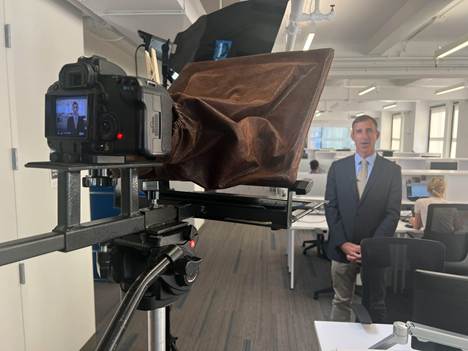
A teleprompter sits directly in front of the lens, used here for a scripted on-camera presentation.
Homemade cue cards are harder still. People sometimes ask us to hold cards near the camera, and all that does is pull their eyes off the lens. Some people can ad-lib around a card, and it works. For those who can’t, we set things up so their eyeline sits as close to the lens as we can get it.
Some clients insist on a script, and we go with it. Others agree to try part of the shoot as a conversation. Sometimes that works and sometimes it doesn’t, but I always give my honest opinion first.
How I put nervous people at ease
Plenty of people tell me they don’t like being on camera. Before we roll, I sit and shoot the breeze with them. I ask where they’re from, how long they’ve worked for the company or whether they have kids. None of it has anything to do with the interview, and that’s the point.
Sometimes I make a joke once the cameras, lights and microphones are all set. I tell them we’re really from 60 Minutes, here to investigate the company’s finances. They know I’m kidding, and a little silliness lightens the mood.
If someone is still nervous, I explain how this works. This isn’t live TV. We’re going to talk for several minutes and use just the best answers you give us. If you stumble, keep going, because we’ll edit it together and make you sound perfect.
It also helps people to know we’re on their side. We’re there to make them look like a rock star. We’d never use an answer that wasn’t their best, or footage that didn’t show them at their best. If a collar is off or their hair is out of place, we say so before we roll.
And if someone stops mid-answer and says they’re awful and can’t put three words together, we take a breath. Then I ask something silly. What did you have for breakfast? Is that your kid texting you? How many times have you been on TikTok today? A laugh resets everything.
The story I always tell is about a tribute video we produced for a nonprofit. We were interviewing the mother and father of the honoree, and the mother had no interest in being on camera. She was nice about it, but she made it very clear she wasn’t comfortable and was only doing it for her daughter. She did an amazing job. Then she walked out, looked at her husband and said, “That was so much fun.”
Three habits I kept from sportscasting
I spent 17 years interviewing athletes, coaches and fans. That meant pros, college and high school players, Little Leaguers, special needs athletes, and everyone from little kids to seniors. Three habits from those years are in every corporate interview I conduct.
Ask open-ended questions. I learned early in my broadcasting days not to ask a question that can be answered with a yes or a no. I ask people to tell me about something, or what an experience was like, or how they were feeling when it happened. With a ballplayer, it was “Talk about your days in the minor leagues.” Some of the best sound bites I ever got came from harmless questions like that.
Stop talking. When the person starts answering, be quiet. When they finish, stay quiet. I give it a solid five seconds. That silence makes people feel they should keep going, and what comes next is often the most honest and meaningful thing they say.
Listen to the answer. Interviewers have an awful habit of being ready with the next question and not hearing the answer in front of them. The best next question almost always plays off what the person just said.
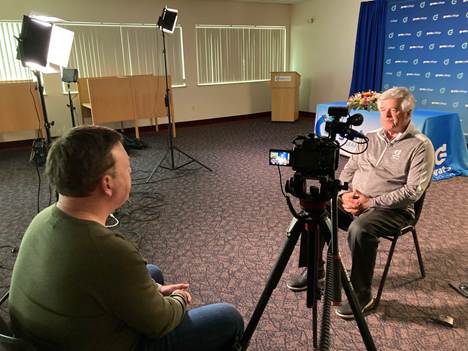
An interview at Gratz College. Once the question is asked, my job is to listen.
Why my interviews run long
Ask anyone on my production team and they’ll tell you I’m the king of epically long interviews. An interview can be as short as a few minutes or run an hour or more. It depends on why we’re talking to the person.
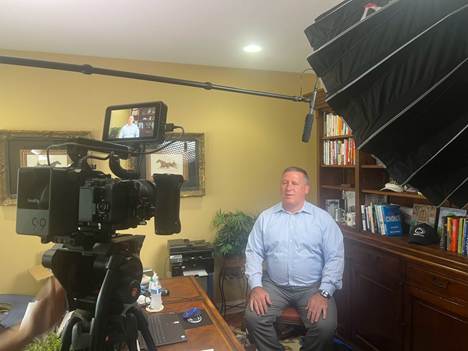
An executive interview on location, as the camera sees it.
Only a small portion of any one interview ends up in a finished video, unless that person is the only one in it. We ask a lot of questions, we get a lot of great answers, and we use the best of them.
The length pays off in another way. A high-level executive rarely has time to sit for an interview. When we do have that person in the chair, I encourage the client to think about what else they might want him or her speaking about for future videos. If we can spend an hour and a half together, we can cover many topics in one sitting. The more videos you plan to produce, the more of that interview you’ll use.
Before your next shoot
If you’re a marketing director planning a video that features your leadership, here’s what I’d do.
- Write a short list of talking points for each person, specific to that person’s expertise.
- Send the lists a few days before the shoot.
- Tell your executives they’ll be having a conversation, and that we’ll only use small portions of the interview.
- If the content is regulated, bring someone to the shoot who can flag a problem on the spot.
- If you have a senior executive’s time, plan extra topics for future videos.
- If a script is unavoidable, break it into short segments.
Then let the person talk. Your executives know the business better than any script does, and viewers can tell the difference between someone reciting and someone who means it.
If you’re planning a video and want to talk through how to prepare your team, I’m happy to have that conversation.