
AI has hijacked the marketing conversation. It’s the headline, the panel topic, the silver bullet everyone swears they’re loading. If you believed the hype, you’d think everything else in marketing had been pushed to the margins.
The 2026 story isn’t who shouts “AI” the loudest. It is who can breathe with it — the teams that have built the lungs for endurance, not just the hype for headlines. AI may be oxygen, but oxygen without lungs is useless. In other words, effectiveness is less about what you bought and more about what your people can do with it. AI won’t magically fix a lack of capability. If anything, it makes capability gaps more obvious.
Nowhere is that dilemma more visible than in content strategy itself.
AI is making marketing faster. But is it better or just weirder?
AI isn’t just in the room anymore. It is the room. According to our research, 95% of B2B marketers say their organizations use AI-powered applications. Here’s where their implementation stands:
- Exploratory (20%)
- Developing (48%)
- Established (24%)
- Advanced (5%)
- Leading (3%)
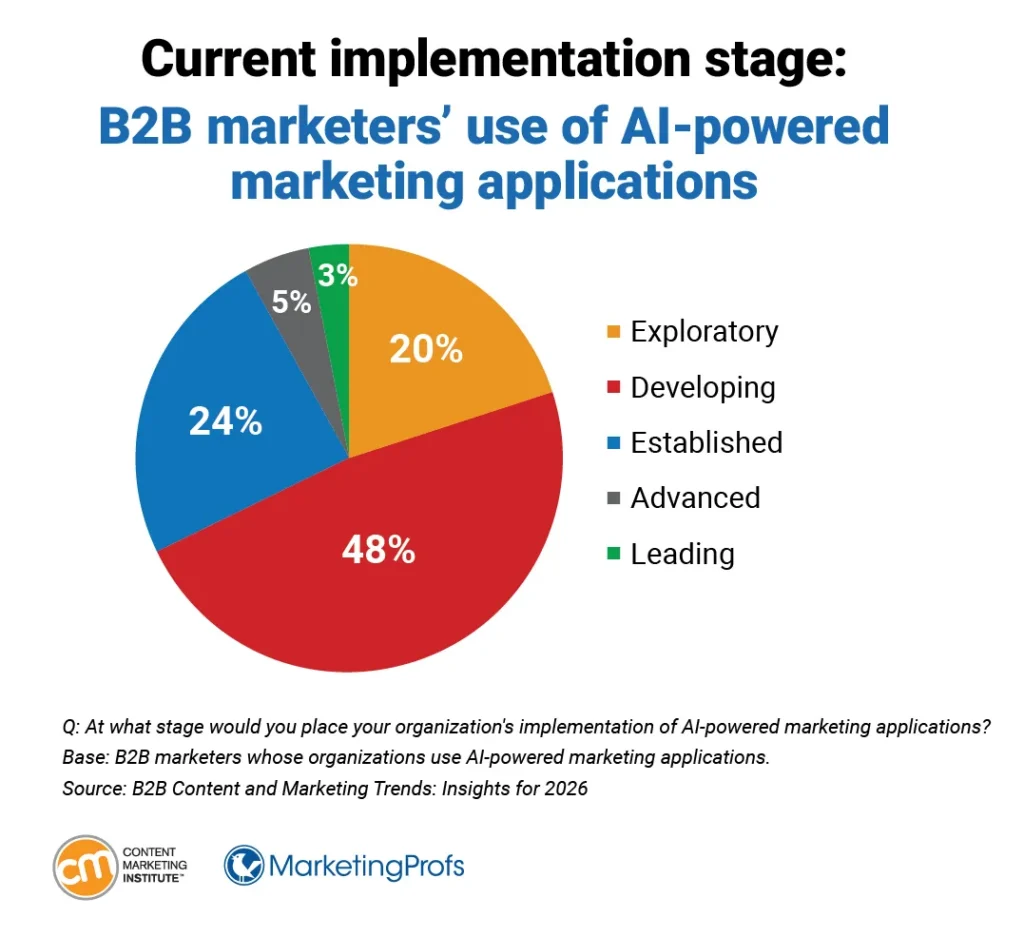
OK, so far, no surprise. Most marketers are exploring or developing their AI approach. So, what are they using?
- Content creation tools for generating or optimizing marketing copy/written content (89%)
- Creative asset tools for generating and editing images, videos, and visual materials (53%)
- SEO tools for analyzing search patterns, recommending keywords, optimizing content for search engines, and predicting ranking improvements (41%)
- Social media tools for content scheduling, analysis, and automated posting (38%)
- Email marketing tools for campaign optimization and personalized email content (36%)
- Market research/insights tools for analyzing trends, consumer behavior, and customer sentiment (35%)
- Conversational tools for automating customer dialogue (chatbots, virtual assistants) (28%)
- Advertising optimization tools for campaign performance analysis/ad spend (16%)
- Personalization tools for customizing experiences based on individual preferences (14%)
- Predictive analytics/targeting tools for forecasting customer behavior/optimizing targeting (12%)

Among the marketers using AI for content creation:
- 87% say productivity has improved, 6% say there’s been no change, 3% say it’s decreased, 1% are unsure, and 3% say it’s too soon to tell.
- 80% say operational efficiency has improved, 11% say there’s been no change, 2% say it’s decreased, 2% are unsure, and 5% say it’s too soon to tell.
- 65% say creative capabilities have improved, 22% say there’s been no change, 5% say they’ve decreased, 3% are unsure, and 5% say it’s too soon to tell.
- 58% say content quality has improved, 21% say there’s been no change, 12% say it’s decreased, 2% are unsure, and 7% say it’s too soon to tell.
- 39% say content performance has improved, 34% say there’s been no change, 5% say it’s decreased, 7% are unsure, and 15% say it’s too soon to tell.

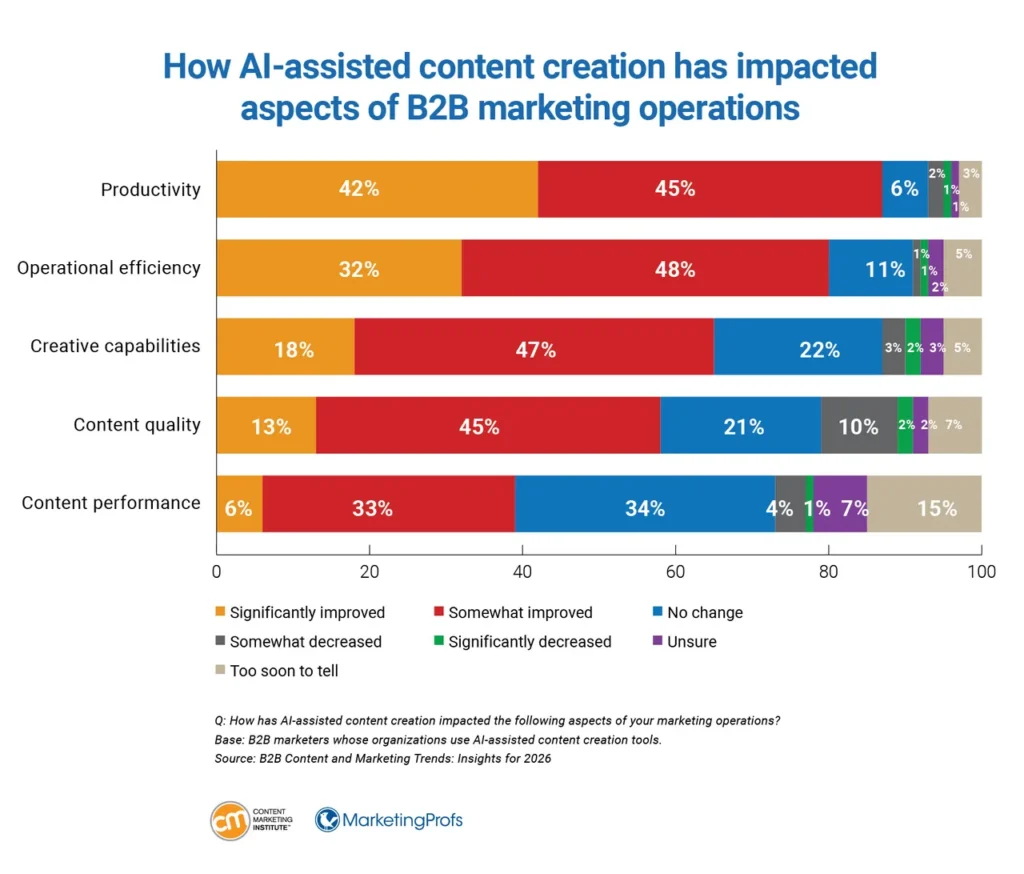
These results are telling. While 68% of marketers say they’re exploring or developing their AI approach, almost nine in 10 already use AI to crank out written content, and half use it to develop or edit creative assets, like images, videos, and visual materials.
In other words, marketers experiment with AI strategy while barreling ahead with AI production. The impact tracks with that split. The big wins? Productivity and operational efficiency. You’re faster. You’re leaner. You’re producing more.
But looking at the deeper measures — creativity, content quality, and performance — the numbers drop. In fact, 12% say the quality of their content decreased with AI.
In addition:
- About a fifth of users don’t see AI moving the needle on creativity (22%) or content quality (21%), hinting that AI might be helpful, but not yet a game-changer in these areas.
Content performance shows the highest combined uncertainty — 22% scratch their heads or say “ask me later” — suggesting they need more time to see how AI impacts content effectiveness.
As AI implementation matures, we may see improvements in these deeper metrics, but as it stands, for the most part, AI helps marketers type faster, not think better.