
AI has hijacked the marketing conversation. It’s the headline, the panel topic, the silver bullet everyone swears they’re loading. If you believed the hype, you’d think everything else in marketing had been pushed to the margins.
But plenty is happening in B2B content and marketing that isn’t AI — and those shifts matter just as much as AI — as CMI’s B2B Content and Marketing Trends: Insights for 2026 report shows.
The headlining takeaway from the survey of 1,015 B2B marketers reads:
Teams winning in 2026 aren’t playing with prompts, churning out more content, or managing to the algorithms. They’re building stronger muscles in marketing fundamentals, then letting AI breathe more creative life into those efforts.
This year, we changed our approach to the B2B research. Instead of slicing marketers by budgets or reporting lines, we segmented them by how well they’re aligning to trends shaping the next few years.
We define the stages of marketers across survey categories as follows:
- Exploratory: Initial implementation with preliminary results being gathered
- Developing: Basic implementation with mixed early outcomes
- Established: Consistent implementation with measurable results
- Advanced: Optimized implementation with strong ROI
- Leading: Industry-leading implementation with exceptional measurable outcomes
Throughout this report, you’ll see the term “pacesetters.” These marketers rate themselves in the established, advanced, or leading stages of adoption in that respective category.
The 2026 story isn’t who shouts “AI” the loudest. It is who can breathe with it — the teams that have built the lungs for endurance, not just the hype for headlines. AI may be oxygen, but oxygen without lungs is useless.
Let’s get into it.
Marketing effectiveness is decent, but underinvestment in needle movers exists
How do marketers rate their effectiveness over the last 12 months? Here’s what the research finds:
3% say they’re highly ineffective (failed to meet goals).
12% say they’re highly effective (exceeded goals).
47% say they’re somewhat effective (met most goals).
31% say they’re neutral (mixed results).
7% say they’re somewhat ineffective (fell short of most goals).
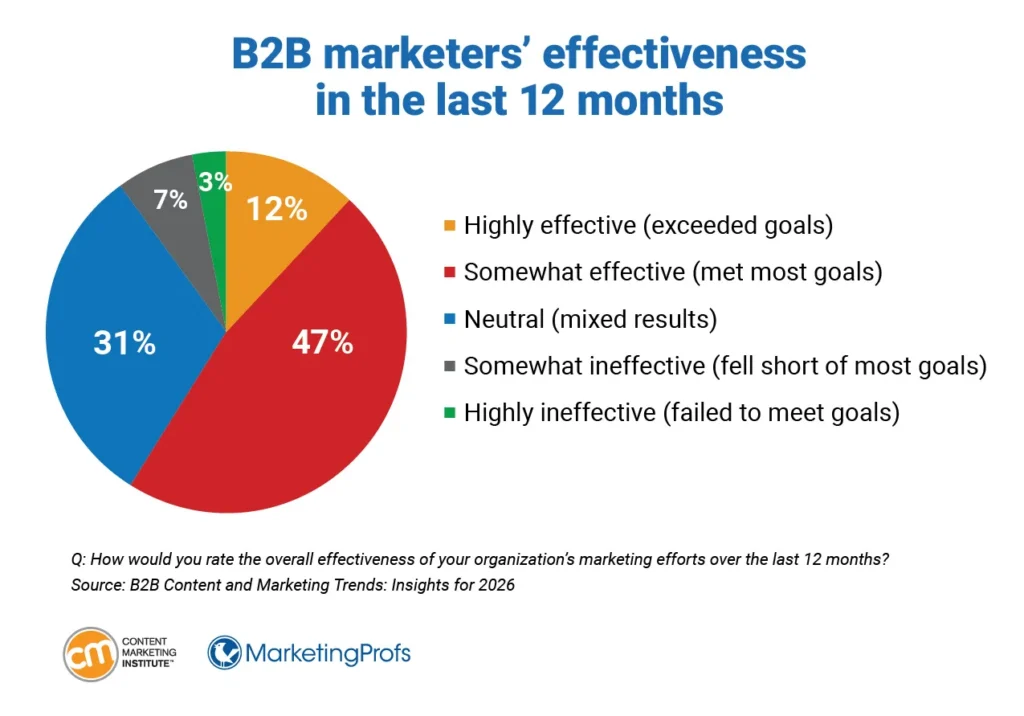
Over half (59%) of marketers think their efforts are at least “somewhat effective.” That’s encouraging. But it also means nearly half are stuck in neutral or struggling.
Here’s the interesting twist: When asked what moved the needle, more than half of the effective teams point to content relevance and quality (65%) and team skills and capabilities (53%), followed by:
- Alignment with sales (45%)
- Technology and tools (43%)
- Customer understanding and segmentation (40%)
- Measurement and reporting (40%)
- Channel selection and optimization (36%)
- Competitive positioning (33%)
- Data quality and analytics capabilities (27%)
- Budget allocation (20%)
- Market conditions (16%)
The two most common responses emphasize people, not budget, not market conditions, not even technology.
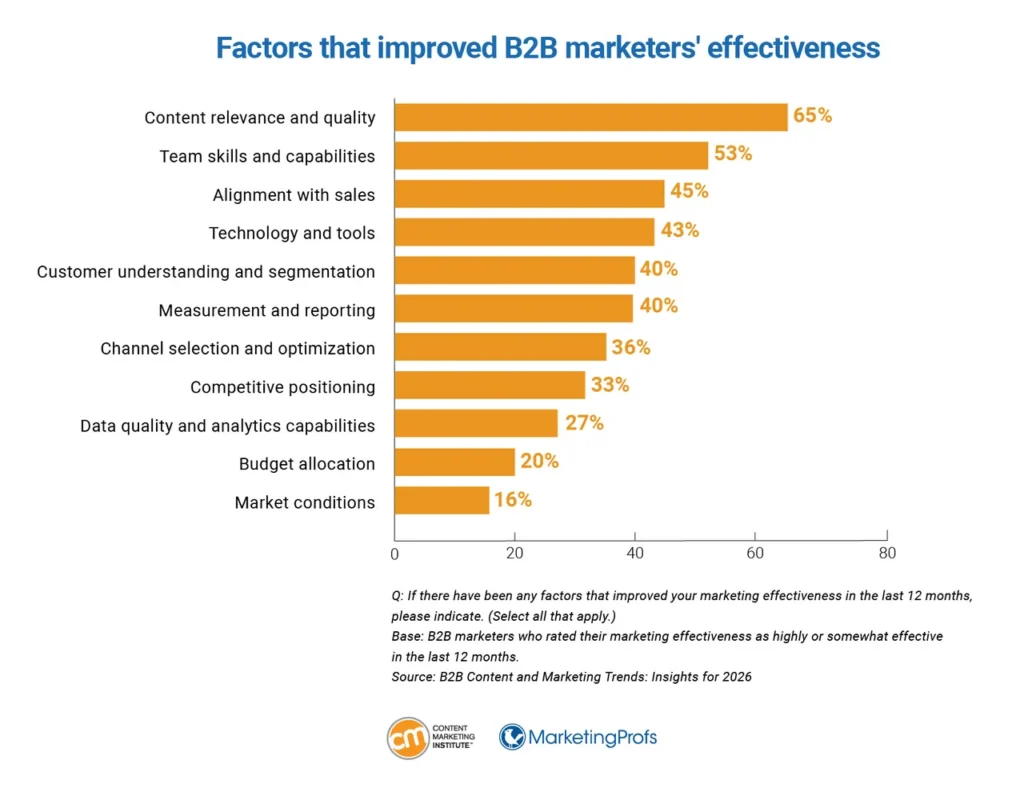
For all the talk about tech stacks and tools, most improvements came from teams getting better at their work. They’ve grown their skills, cross-functional muscles, and ability to adapt.
In other words, effectiveness is less about what you bought and more about what your people can do with it. AI won’t magically fix a lack of capability. If anything, it makes capability gaps more obvious.
Nowhere is that dilemma more visible than in content strategy itself.
Content strategy effectiveness is up, thanks to tech and people
Last year, marketers were “meh” about their content strategies — a lot of average, a lot of stability, not much movement.
This year? A different story. Ninety-seven percent of marketers told us they have a content strategy (only 3% don’t). Among those with a strategy:
- 13% say it significantly improved (clear growth in results and ROI).
- 48% say it somewhat improved (modest gains in effectiveness).
- 30% say it remained stable (consistent performance with minimal change).
- 8% say it somewhat declined (noticeable decrease in effectiveness).
- 1% say it significantly declined (major reduction in results and ROI).
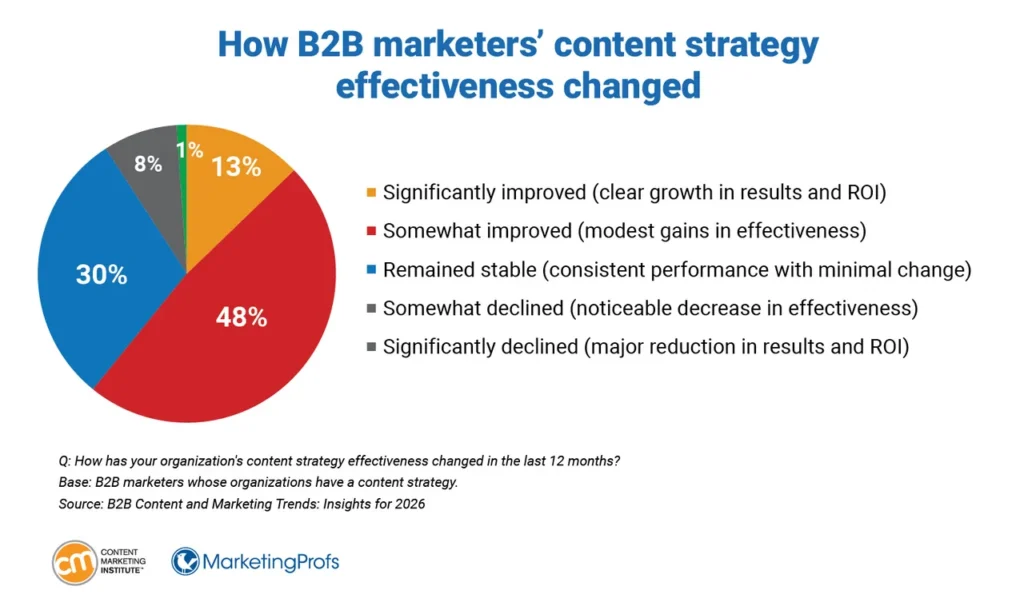
That’s 61% of marketers who report improvement. Yes, new technology played a role (51% credited new technology implementation), but look closer. The biggest driver of improvement is people-related, with 74% pointing to strategy refinement. In addition, 40% cite team restructuring and resource changes (another people factor), followed by measurement capabilities (26%), budget adjustments (16%), market conditions (14%), competitive landscape shifts (13%), and audience behavior changes (10%).

In other words, technology helped, but human choices sharpened the strategy that moved the needle. This is the payoff of getting intentional.
Marketers finally moved beyond the stage of “do we even have a strategy?” and improved on the one they’ve got. Two points stand out:
- Strategy beats scale. The biggest driver of improvement wasn’t more budget; it was refining the plan. Translation: fewer random acts of content, more coordinated direction.
- Tech is only half the story. Yes, 51% credited new tools (AI, automation, etc.) as a contributing factor, but that choice lagged behind good old-fashioned strategic refinement. Tools don’t create strategy; they amplify it.
The irony? The marketers who upgraded their strategy now have a fighting chance of getting ROI out of their tech. Without that strategic backbone, even the flashiest AI tool is just lipstick on a PDF.
Challenges marketers still can’t shake
Progress aside, hurdles still exist. When asked to select their top three content marketing challenges, B2B marketers say:
- Creating content that prompts a desired action — e.g., conversion (40%)
- Resource constraints — time, people, budget (39%)
- Measuring content effectiveness (33%)
Other challenges include creating enough quality content to meet our organizational needs (28%), differentiating content from competitors (24%), aligning content with the buyer’s journey (23%), cross-department collaboration (21%), understanding audience informational needs (20%), developing a content strategy and plan (16%), aligning with sales objectives (15%), technology integration (8%), and content governance and compliance (6%).
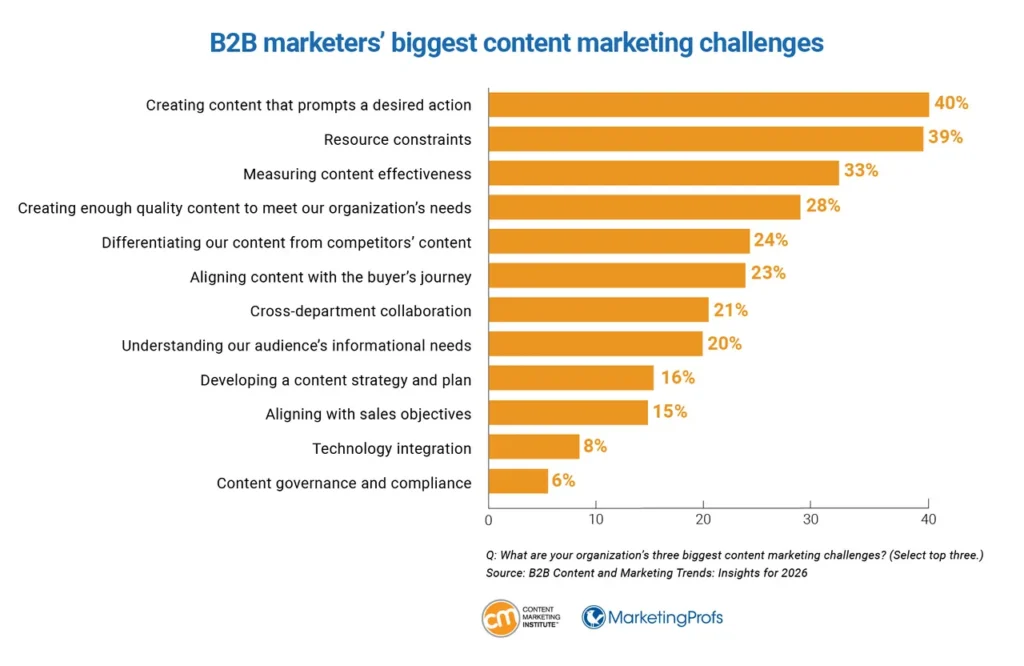
What jumps out in these results is their sheer familiarity. The most common challenges are the same as those identified in last year’s survey. That tells me two things:
- Tools don’t erase fundamentals. Marketers are drowning in AI and automation demos, but the biggest barrier is still human: How do you make content that someone wants to click, read, or act on?
- Measurement is the canary in the coal mine. A third of marketers admit they struggle with measuring effectiveness. If you can’t measure, you can’t prove value. And if you can’t prove value, you’ll always be first in line for budget cuts.
Here’s the kicker: Resource constraints and measurement aren’t separate challenges — they’re the same problem. Teams without clear measurement frameworks look like they’re doing “a lot” without showing “enough.” Cue the CFO tightening the purse strings.
Is your social media strategy ANTI-SOCIAL? Let’s review & elevate your social media.